

1. The Hidden Financial Drain of Legacy Tape Edge Operations
Operational Bottleneck AnalysisRelying on legacy, semi-manual tape edging tables introduces severe labor overheads and persistent production bottlenecks. Operators spend excessive time manually lifting, pushing, and turning heavy mattress assemblies, leading to physical fatigue, inconsistent cycle times, and an inflated cost-per-bed.
Labor Dependency Factor
- Operational Inefficiency: Manual handling requires two or more skilled operators per line to manage heavy flipping and corner guiding, driving up recurring labor costs.
- Technical Solution: Modern automated machinery integrates conveyor belts and pneumatic turning arms that eliminate manual lifting entirely, reducing labor headcount requirements per shift.
Cycle Time Variance
- Throughput Limitation: Operator fatigue directly slows down sewing speeds during the final hours of a shift, destabilizing daily output projections.
- Technical Solution: PLC-driven systems maintain a constant, optimized sewing cadence regardless of shift duration, guaranteeing predictable hourly output.
2. Boosting Hourly Throughput with Servo-Driven Controls
Speed & Precision ParametersAchieving high factory throughput requires precise synchronization between the sewing head, conveyor speed, and corner deceleration. Advanced servo architectures eliminate mechanical lag, allowing the machine to operate at maximum velocity on straight edges while executing intelligent slowdowns at corners.
Dynamic Speed Scaling
- Velocity Control: Traditional mechanical clutches wear out quickly and offer blunt speed adjustments, causing thread snaps at high speeds.
- Technical Solution: Full servo control coordinates the sewing head and feed mechanisms digitally, enabling peak speeds up to 1,400 RPM while ensuring flawless stitch formation.
Corner Deceleration Logic
- Quality Risk: Abrupt corner turns without speed reduction cause needle deflection, skipped stitches, and frayed binding tape.
- Technical Solution: Built-in optical sensors and PLC programming automatically decelerate the sewing head precisely as it approaches corners, preserving seam integrity.
3. Eliminating Material Scrap and Achieving Zero-Defect Seams
Material OptimizationFabric scrap and defective tape-edging directly eat into factory profit margins. When binding tape puckers or stitches stray off the mattress edge, the entire unit requires costly rework or must be downgraded, wasting expensive border and panel materials.
Seam Alignment Accuracy
- Scrap Generation: Manual guiding inevitably leads to wandering seams on thick pillow-top mattresses, resulting in high rejection rates.
- Technical Solution: Automated edge-positioning guides and adjustable presser feet firmly anchor multi-layer panels, ensuring straight, aesthetic sutures on every cycle.
Thread Break Management
- Downtime Factor: Unnoticed thread breaks result in meters of unstitched tape before the operator reacts, ruining the panel.
- Technical Solution: Integrated infrared and electronic thread-break detection sensors instantly trigger an automatic stop, preventing material damage and reducing waste.
4. Engineering Robustness and Low-Maintenance Plant Operations
Mechanical DurabilityFor factory owners, equipment reliability directly dictates return on investment. Machines constructed with lightweight frames or substandard internal linkages suffer from excessive vibration, frequent calibration drift, and recurring maintenance downtime that halts production lines.
Vibration Dampening
- Structural Integrity: High-speed sewing generates intense harmonic vibration that loosens standard fasteners and misaligns internal components over time.
Lubrication & Wear Resistance
- Maintenance Overhead: Manual greasing points are frequently neglected by busy shop-floor staff, leading to premature bearing and gear seizure.
- Technical Solution: Modern sewing heads feature automatic oil supply systems that circulate lubricant continuously, extending component lifespans and minimizing upkeep.
Essential Tape Edge Machinery for High-Output Plants
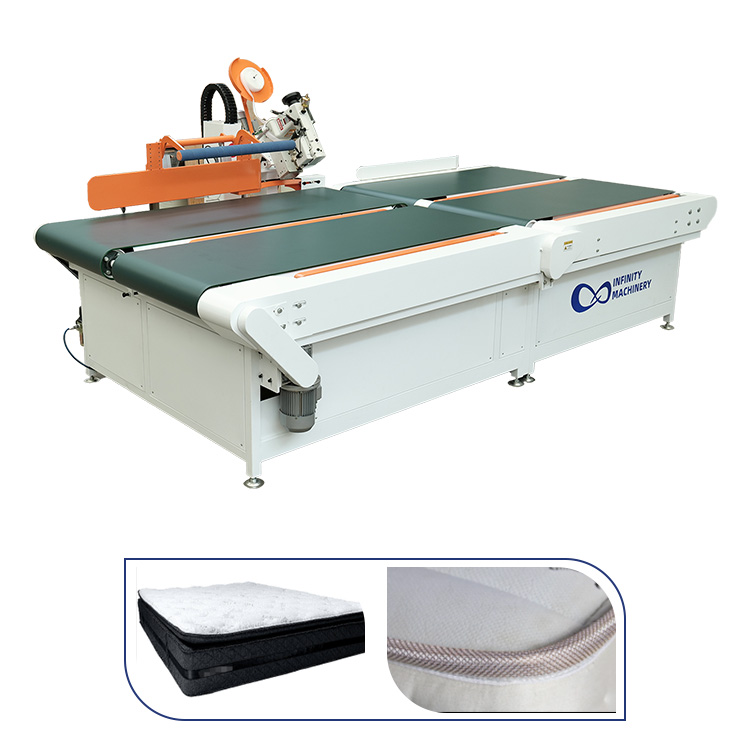
Fully automatic tape edge machine featuring robotic arms, automatic 90-degree turning, and PLC control to eliminate manual flipping and maximize plant productivity.

Ergonomic high-speed tape edge machine equipped with advanced servo systems for precise sewing, automatic flipping, and stable performance across thick mattress panels.
5. Seamless Plant Integration and Footprint Optimization
Layout EngineeringFactory floor space is a premium asset. Introducing new machinery must not disrupt the existing material flow between quilting lines, assembly stations, and final packaging units. Compact, well-engineered tape edge systems optimize spatial utilization without compromising working table dimensions.
Floor Plan Flexibility
- Spatial Constraints: Bulky machinery with awkward external power supplies or control consoles creates bottlenecks and clogs transit corridors.
- Technical Solution: Integrated console designs and built-in rotating electrical power supplies eliminate external wiring clutter, fitting easily into existing production layouts.
Conveyor Synchronization
- Workflow Friction: Manual handoffs between the sewing table and downstream inspection stations create accumulating work-in-progress (WIP) piles.
6. Labor Reduction and Safety Compliance on the Factory Floor
Workforce ErgonomicsWorker injury risks associated with lifting heavy, multi-layered mattresses present significant liabilities for plant owners. Modern automated machinery shifts the physical burden from human operators to robotic arms and pneumatic lifters, improving safety metrics and staff retention.
Ergonomic Relief
- Injury Liability: Repeated manual rotation of 40kg+ mattresses causes chronic lower back strain, resulting in high absenteeism and workers' compensation claims.
- Technical Solution: Pneumatic compression and automatic flipping mechanisms handle heavy lifting entirely, protecting operators from physical strain.
Operator Training Curve
- Skill Scarcity: Finding veteran tape-edge operators who can maintain high speeds manually is increasingly difficult and costly.
- Technical Solution: Touch-screen digital interfaces and intuitive PLC controls allow new operators to achieve proficiency rapidly with minimal specialized training.
7. Calculating Return on Investment (ROI) for Plant Upgrades
Financial EvaluationCapital expenditure on new equipment must be justified by a clear amortization timeline. By calculating the combined savings from reduced labor headcounts, eliminated material scrap, and doubled hourly output, factory owners can typically achieve full ROI on advanced tape edge systems within 12 to 18 months.
Cost-Per-Bed Reduction
- Margin Expansion: High labor costs and low daily piece-counts inflate the manufacturing overhead of every mattress produced.
- Technical Solution: Doubling output per shift while cutting labor requirements in half drives down the direct manufacturing cost per unit, maximizing profit margins.
Scalability Impact
- Growth Bottleneck: Manual operations limit a factory's ability to accept large-volume retail contracts due to unpredictable delivery timelines.
- Technical Solution: Reliable, high-speed automated equipment provides the production capacity necessary to scale output and fulfill major commercial orders with confidence.
Strategic Plant Investment Takeaway
Upgrading from legacy manual operations to automated mattress tape edge machinery is not merely a tactical equipment purchase—it is a foundational financial strategy. By eliminating labor bottlenecks, slashing material scrap, and dramatically increasing daily output per shift, factory owners can permanently reduce their cost-per-bed and secure long-term market competitiveness.
Ready to Optimize Your Mattress Production Line?
Partner with Infinity Mattress Machinery to integrate high-efficiency automated equipment and maximize your plant profitability.


